



We now have enough production evidence to name the phenomenon more precisely.
The anonymous report limit is not just a pricing fence.
Inside dense cyber clusters, it behaves like a shared investigative commons.
One actor can often work inside it comfortably. Then other actors in the same network estate arrive, the shared budget depletes, and the surface begins to change shape underneath them.
That is the squeeze.
1. The field we measured
Using the production database over the trailing 14 days, we scanned city-level report activity across the public detail-report surface and separated:
- successful anonymous reads:
200 - canonical churn:
301 - quota pressure:
302
At the global level, the field looked like this:
25,589city clusters with real200and/or302report activity401,897successful anonymous200reads1,315,890quota302redirects12,248organization-days where the same cluster got successful reads first and then hit the quota wall later that day24,545organization-days that arrived already squeezed
So the global pattern is not outright denial.
It is:
- some successful reading
- later collision with the anonymous budget
- and many later arrivals reaching the surface after a sibling actor has already spent part of the daily allowance
2. The strongest squeeze clusters
The clearest city clusters in the current field are:
- Ho Chi Minh City
- Singapore
- Hanoi
- Ashburn
- Baghdad
- Lahore
- Caracas
Their common structure is not just traffic volume.
It is the combination of:
- real successful anonymous reading
- same-day transition from
200to302 - redirect-only arrivals
- and evidence that multiple actors inside the same city or network context are sharing one finite budget
3. Why this is a real economic pattern
The best economic category for what we are seeing is a common-pool resource problem.
The anonymous report allowance behaves like a small finite resource that is:
- usable by one participant
- rivalrous once more participants arrive
- degraded by overuse
- and hard to coordinate fairly when the actors do not explicitly organize with one another
That makes the anonymous quota feel much less like a personal subscription boundary and much more like a temporary shared commons inside a network estate.
This is closely related to:
- tragedy of the commons
- congestion pricing
- load shedding
- shared egress / NAT externalities
- flash-crowd arrival effects
Those are not metaphors layered on top of the data. They are direct matches for the behaviors in the stream.
4. What kind of game is it?
In game theory terms, this looks most like a repeated congestion game with common-pool-resource failure modes.
Each actor chooses, implicitly:
- keep reading through the anonymous shared surface
- slow down and preserve the shared budget
- move into owned workspace quota
The problem is that under anonymous shared access, the local incentive is not to preserve the commons.
The local incentive is:
get your reads now, because someone else in the same estate may consume the budget before you do
That creates a familiar coordination failure:
- individually rational behavior pushes actors to consume while the surface is available
- collectively, that behavior degrades the experience for everyone in the same estate
This is why the field often does not look like one analyst exploring calmly.
It looks like a mixture of:
- early successful reads
- later collisions
- and trailing actors who arrive to find the budget already spent
5. The limit does seem to support one analyst
This is the most important commercial finding.
For most of the strongest squeeze clusters, a large majority of successful organization-days still stayed within the current 30-read budget:
- Singapore:
62.71% - Ho Chi Minh City:
77.46% - Hanoi:
88.57% - Ashburn:
86.36% - Baghdad:
83.43% - Lahore:
95.48% - Caracas:
96.68%
That is surprisingly supportive of the current pricing intuition.
It suggests the limit often does allow:
one analyst inside one organization to complete a reasonable daily pass
The squeeze begins when the actor population widens inside the same network context.
That is a very different story from “the cap is too low for any useful work.”
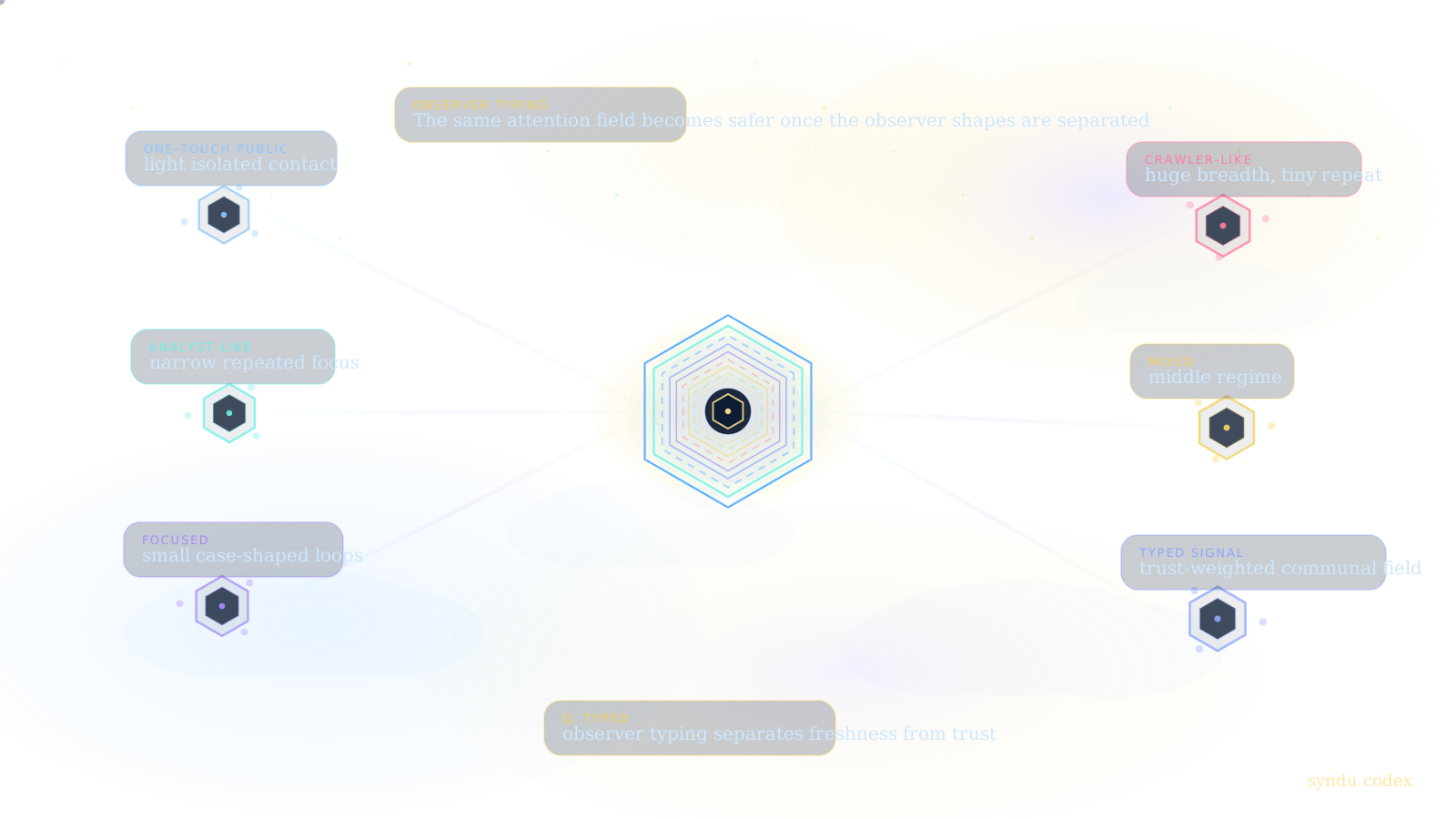
6. Three different squeeze archetypes
Once we zoom into the strongest clusters, three distinct market behaviors appear.
A. Diffuse shared-estate squeeze
These clusters look like many sibling IPs spread across broad infrastructure estates, each extracting only a little value before redirect pressure becomes dominant.
Examples:
- Ho Chi Minh City
- Hanoi
- Singapore
- Ashburn
Typical fingerprint:
- low successful reads per IP
- high
302/200pressure ratio - many multi-IP organizations
This is the classical horizontal adaptation pattern. The quota becomes a city-wide or estate-wide commons problem.
B. Human-population squeeze
These clusters look more like real user populations operating through local telecom contexts than pure cloud spray.
Examples:
-
Baghdad
Top organizations: EarthLink-linked telecom estates -
Lahore
Top organizations: In Cable Internet, Pakistan Telecommunication, CMPak -
Caracas
Top organizations: Net Uno, CANTV, VIGINET
These clusters show:
- large successful
200volume - many successful networks
- high within-budget share
- recurring same-day success then squeeze
This looks more like a real investigator population sharing a communal network constraint.
C. Compact deep-reading squeeze
These clusters are different again. They show fewer IPs, much deeper reading per IP, and then eventual collision with the wall.
Examples:
- Queens
- Atlanta
- Tukwila
- Columbus
This looks closer to concentrated analyst or platform behavior: not broad spray, but a small number of persistent actors reading deeply enough to encounter the limit.
7. What your end customers are actually experiencing
If a customer stays inside the anonymous shared surface, their lived experience is probably not:
I was suddenly shut out
It is more likely:
- I can usually get some real value first.
- If I am alone in my estate, the limit often feels workable.
- If other actors inside my estate are active too, the surface starts to feel inconsistent.
- Sometimes I get through, sometimes I arrive late and the budget is already gone.
- The experience becomes harder to trust as my own team or neighboring actors proliferate.
That is what makes the squeeze commercially important.
It creates a transition from:
- opportunistic anonymous usefulness
to:
- unreliable communal access
and that is exactly where owned workspace quota becomes valuable.
8. The real product move
The answer is not just to say “upgrade.”
The answer is to explain the transition clearly:
move from a shared anonymous network budget into a workspace quota that belongs to you and your team
That language matches the structure of the game.
It tells the customer:
- why the anonymous surface felt good at first
- why it starts to feel unstable later
- and what changes once they stop sharing the commons
9. The concise read
The anonymous report squeeze is not a mystery and not a failure of the data.
It is a recognizable market dynamic:
- economically, a common-pool resource under congestion
- game-theoretically, a repeated congestion game with coordination failure
- commercially, a transition point where a useful anonymous surface becomes too communal to trust at team scale
That is what the production field is showing us.
And that is why the most important commercial sentence is not about more quota by itself.
It is about ownership.