syndu | March 3, 2025, 8:26 a.m.
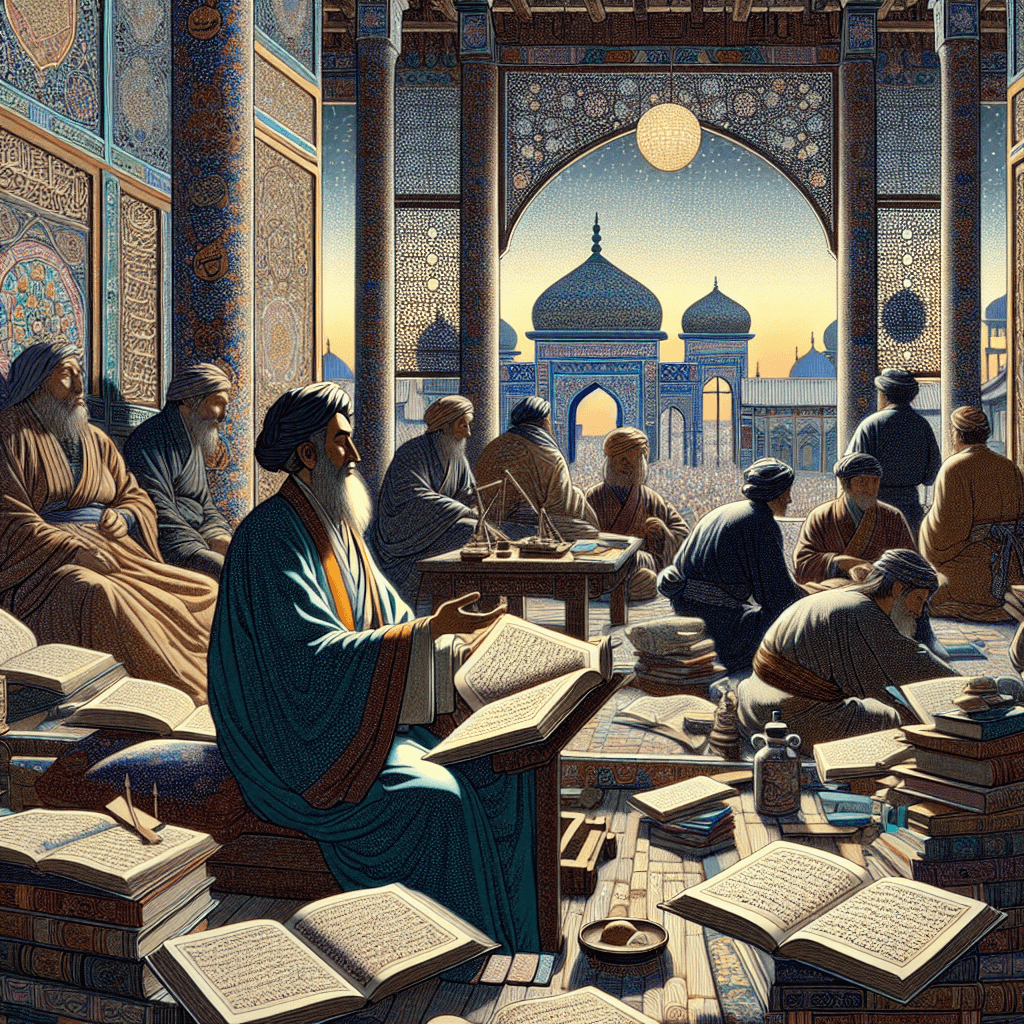
Setting the Scene: The House of Wisdom
In the heart of the 9th-century Abbasid Caliphate, Baghdad stood as a beacon of knowledge and innovation. It was here, amidst the bustling streets and vibrant markets, that the House of Wisdom flourished—a grand library and intellectual hub where scholars from diverse backgrounds gathered to exchange ideas and push the boundaries of human understanding. Among these luminaries was Al-Khwarizmi, a pioneering mathematician whose work would lay the foundation for modern algebra and computation.
Al-Khwarizmi's Foundational Contributions
Al-Khwarizmi's contributions to mathematics were nothing short of revolutionary. His seminal work, "Al-Kitab al-Mukhtasar fi Hisab al-Jabr wal-Muqabala" (The Compendious Book on Calculation by Completion and Balancing), introduced the world to the concept of algebra (al-jabr). This treatise provided systematic solutions to linear and quadratic equations, establishing a new mathematical language that transcended cultural and linguistic barriers.
Beyond algebra, Al-Khwarizmi's influence extended to the realm of algorithms—a term derived from the Latinization of his name.
His work on arithmetic and the Hindu-Arabic numeral system facilitated more efficient calculations, paving the way for advancements in commerce, astronomy, and engineering.
Commerce and Innovation in 9th-Century Baghdad
During Al-Khwarizmi's time, Baghdad was a thriving center of trade and commerce. The city's strategic location along the Silk Road made it a melting pot of cultures and ideas, where merchants and scholars alike converged to exchange goods and knowledge. This dynamic environment fostered a spirit of innovation, as new mathematical techniques were applied to solve practical problems in trade, navigation, and finance.
Al-Khwarizmi's mathematical insights were instrumental in refining methods of interest calculation and risk assessment, which were crucial for the burgeoning commercial activities of the time. His work provided a framework for understanding and managing financial transactions, laying the groundwork for future economic systems.
Foreshadowing a Journey Through Financial Revolutions
As we embark on this journey through the financial ages, we will follow Al-Khwarizmi as he "awakens" in different historical eras, witnessing firsthand how his mathematical principles have been adapted and transformed. From the Renaissance banking systems of Florence and Venice to the rise of modern capital markets and the digital finance revolution, Al-Khwarizmi's legacy continues to resonate.
Through his eyes, we will explore the evolving landscape of financial interest, debt, and capital management, examining how these instruments are perceived in terms of utility, risk, and religious considerations. This journey will illuminate the enduring power of algebra to shape economic systems and inspire thoughtful discourse on the balance between innovation and ethical responsibility.
Conclusion
In this introduction, we have set the stage for Al-Khwarizmi's time-traveling journey—a narrative that connects math, finance, history, and religion. As we delve deeper into each era, we will uncover the profound impact of his work on the financial world and reflect on the timeless wisdom that continues to guide us in navigating the complexities of modern finance.